|
|
Abkhazia
Legal basis of statehood and sovereignty
All the history of struggle of the peoples of the
Caucasus is
a struggle for their beautiful land,
for the preservation of customs and
traditions.
It is a struggle to stop anybody attempting to take our life.
Mussa Shanibov,
President of the Confederation of the Peoples of the Caucasus
Introduction
The concept “History of Abkhazia” in domestic and world historical
literature is treated and applied as the history of a separate country. However,
some Georgian (and other) historians represent Abkhazia as a component of
Georgia, i.e. there are two mutually exclusive opinions. In one case Abkhazia is
Georgian - more precisely speaking, a part of Georgia; in the other, Abkhazia is
an independent country, not being an organic part of Georgia but included in
the structure of Georgia at a certain historical stage.
Statements of historical processes by some Abkhazian historians are not free
from the ideological influence set in works of such Georgian historians as G.
A. Melikishvili, P.Ingorokva, etc. Z. V. Anchabadze and S.D.Inal-Ipa wrote about
the Abkhazian kingdom as Georgian. Bagrat III and subsequent rulers were
represented by them as Georgian tsars, and Abkhazia in IX-XI centuries was
preoccupied, in their opinion, with only one problem - creation of the
incorporated Georgian state. This has compelled us to refer to primary sources
and to consider in more detail the reasons for an incorrect statement of history
by the specified authors. For example, G. A. Melikishvili in the work “About
an origin of the Georgian people”, without any clear historical basis,
identifies Kurds (Kardukhs) with Kartvelians. In addition, he firstly transfers
the historical period of the Kartvels to the middle of II millenium BC, and
secondly transfers their habitation area from the Central Transcaucasia to
mountains of the Peredneaziatski Tauri. Historic facts or confirmations of
them are not presented. As was proved in 1891 by P.I.Nadezhdin1, Kardukhs
living during this period in areas of the Armenian highlands are Kurds, the
people of the Iranian group, instead of Kartvelians.
The first data about Kartvelians (Kartls) are given in Kartlis Tskhovreba ,
a work originally published in Tiflis in the XVIII century in which they
are referred to as living in the VIII century. The toponym, eponym and ethnonym
“Kart, Kartli” do not appear in sources until XI - XII centuries, and Kakhetia
is mentioned for the first time in X century.
Any transfer of Kartls in space and time by a Georgian historian is not
proved by anything. So, on Kipert’s map referring to the time of Dary and Kserx,
only Colchians, Moskhs, Caspians and Alarodis appear in Transcaucasia.
Referring to a map of Caucasus from IX-VII BC, I.M. Diakonov speaks only about
Colchis, Urartu, Daiana, Mana and Assyria and does not see any Karts in the
Central Caucasus. K.P. Patkanov also says nothing about them, giving the
description of internal areas of the country Iveria in VII century AD. Neither
M. Horenatsi nor Kagnkatvatsi write directly about Kartls in their
original notes created respectively in V and IX centuries AD.
The opinion of G. A. Melikishvili is not an error or oversight. It is his
position as a historian, and it is difficult for us to explain why an
acknowledged expert has falsified history. Possibly, national patriotism
and the political situation played a role, and possibly the circumstances which
developed during the Stalin cult and the threat of reprisals in the country.
Also it is necessary to notice that in the majority of the works of G. A.
Melikishvili, describing the history of the country, the contents are
based on falsification of historical material to create a chauvinistic thesis,
namely: “Georgia uber аllеs!”.
Many other Georgian historians display a similar attitude in their works. We
will refer to the opinion of academician Brosse who says that “ the Georgian
chronicles cannot be called in a strict sense history, especially concerning old
times. They have not been created by eyewitnesses nor by
contemporaries”. D.Bakradze (1856) also says: “They are in essence a simple set
of legends, and from them it is impossible to demand the accuracy which
distinctively characterises modern historians..., as they were written in the
second half of II millennium AD, and represent and treat events of I BC – I AD
in the absence of initial historical materials of that period”. It is known
that Kartlis Tskhovreba was written in 1703-1721.
According to I.Chopin (1866):
“The testimony of the author does not give necessary reliability to his work,
especially regarding ancient history: being alien to historical erudition and
scooping without analysis from doubtful sources, compilers have allowed
incorrect news on almost each page of the book, denying this news with
synchronism and common sense, as the reader will see.... It should all be
accepted as the latest fantasy, not having any basis and hence not as history,
but a legend, including telegraphic relations with Palestine and Moses about
which not a word is mentioned in original sources”.
1 Hereinafter we refer to the works listed at the end of the book
The falsification of the history of Transcaucasia is paradoxically proceeding
today. V.Makhnach, publishing a vast article in the magazine "ГражданинЪ" (“The
Citizen”), states and proves the pro-Georgian theory of the existence of the
"Georgian" state since Ш BC, and the “Georgian ethnos” since II BC. This is
more serious than G.A.Melikishvili's opuses. As the stated theory contradicts
historic facts, we have the right to ask the question: What is it - incompetence
of the author or his position?
The concept “Abkhazia is a part of Georgia” initially assumes an idea about
the presence of double indigenous aboriginals (the Georgian and Abkhazian) in
Abkhazia. And this idea forces its way, despite its full contradiction with the
facts of the historical science of this territory. For an establishment of the
fact of the absence of "Georgian" in Abkhazia there is no necessity to search
for such facts in deep layers of the history of centuries - they were not here
till the end of XIX century. The invasion of the Central Transcaucasia by
Abkhazians in IX century and establishment of the Abkhazian kingdom in the
acquired territory which included subdued tribes alien to the Abkhazian ethnos
(Kartvelians, Mingrelians *, Svans, etc.), does not give the right to consider
the Abkhazian conquerors as a component of Kartvelian ethnos.
These peoples differ in every way. The Abkhazian language has nothing in
common with modern Georgian, except for some everyday words which have come to
it as a result of close joint residence. The centuries-old material-spiritual
culture of the Abkhazian people “Apsuara” has no analogue in Georgia. Rituals
and a pantheon of the Abkhazian ancient gods do not coincide in any way with
those of the people of Iberia. Legends of the people of Abkhazia and Georgia
have nothing in common. It is a fact that in IX-XV centuries the Abkhazian
kingdom consisted of not only the states of the Western Caucasus, but also the
countries of Central Transcaucasia (Kartalinia, Каkhetia, Imeretia, Eretia, Tao-Klardzheti
etc.). This does not give any historical basis to the postulate that Abkhazia is
a part of Georgia. Distinction of ethnocultures also proves that Abkhazians,
who ostensibly lived in the environment of "the Georgian ethnoculture”, did not
become its followers, did not take advantage of the written Georgian language,
and have kept their own language and ethnoculture. Such are the facts.
Statements that Abkhazia was and remains a component of Georgia, Georgian
politicians and historians are compelled to build, as G.A.Melikishvili did, on
the basis of opinions, instead of the facts.
We did not put before ourselves the problem of writing a classical sketch of
the history of the country. The present work represents an ordered list of
historic facts presented mainly on the basis of the primary sources, and allows
us to draw conclusions regarding the groundlessness of Georgian claims on
the sovereignty and territory of Abkhazia.
Historians, analyzing the termination of existence of the Abkhazian kingdom,
specify the principal cause as the formation and strengthening of Kartalinia
and its claims for hegemony in this area. This took place, but the principal
cause was different. It lay in the creation, evolution and disorder of all
empires of the world, and consisted of a constant increase in the quantity of
problems connected with the management of increasing structure, due to the
attachment of territory occupied by peoples different in language, character,
and customs. For the management of such a complicated state structure which has
not united voluntarily and shows continuing resistance, great strengths
and human resources of the mother country (in this case, Abkhazia) are required
for the suppression of discontent, for taxation, and for the maintenance of
calm in colonies and protectorates. Also there comes the moment when
centrifugal forces start to prevail, resistance grows everywhere, there are
external enemies and intrigues of opposition in the empire - and all falls. So
it was with the Roman and Byzantine empires. The Russian empire, as well as its
successor the USSR, have passed the same way and have failed independently
without external influence. Similarly there is also present-day Georgia, “A
small empire with big ambitions”, created by the efforts of incompetent
politicians, who do not understand the course of history and its laws. They
are using military expansion, terror, genocide and external support to keep
freedom-loving Caucasian people, who are ethnically alien to them, under their
power.
The Abkhazian kingdom did not fail as a state structure, but as a result of
the capture of Kartalinia and Каkhetia by Arabians, and its borders were
displaced to the West as far as the Lihsky mountains. In addition, a new
dynasty of tsars came to power at the beginning of II millenium AD – Armenian
Bagratids representing the ancestral lands of Tao-Klardjheti and led by Bagrat
III, whose title was “the Tsar Abkhazian and Novelissimus of all the East”. No,
not tsar of Georgia, nor of Kartli or Iberia, but of Abkhazia.
* In the historical literature of the different periods the terms Megrels,
Migrels, Mingrelians are used. In our work the term "Mingrelians" is applied. In
citations the term of authors is kept.
With the falling of Armenia as an independent state, and its enslavement,
the eastern frontier of the Abkhazian kingdom was displaced further to the West.
During this period it settled down only in the territory of the western coast
of the Black Sea. Its tsars carried the name "Abkhazo-Imeretinsky". Kartli, from
the moment of its occurrence, was nothing remarkable, just an ordinary state
formed as a typical princedom of which there were ten in Transcaucasia. It is
not necessary to speak about any of its military achievements or political
merits, as this territory was constantly exposed to invasions or annexation
from Persians, Romans, Arabians, Khorezmians, Khimerians, Khazars, Urartuans,
etc. both before its formation, and during all subsequent periods. It is also
impossible to say anything about the blossoming of this kingdom during any
period of its existence, as this site of Transcaucasia did not, until the end of
XVIII century, have any ten-year period free from invasion by overseas
aggressors reducing cities and settlements to ashes, withdrawing women and
children into slavery, and killing men.
Kartli and its neighbouring kingdoms were continually trampled down by the
same Mongols, Turks, Persians, Arabs, etc. throughout almost two millennia, in
both a direct and figurative sense. In the given situation it is not possible to
speak about the ethnic purity of Kartls (Georgians, in modern understanding). It
is also necessary to notice that in so-called Georgia, (meaning Kartli),
governors did not belong to the native ethnos. They were Arshakids - the
Armenian Persians, Bagratids - the Armenian descendants of Khanaenians,
Selevkids - Hellenes, etc. Also, the first tsar Farnaoz was Persian.
The historical broth in the Western Transcaucasia cooked to the Middle Ages
and the evidence of that is frequent changes to the names of cities, the names
of ethnic groups within the population, and toponyms, in particular the names
of the rivers. This is particularly noticeable at the Western coast of Caucasus,
where the territory history has been registered since the times of the
Argonauts. The new people arrived and introduced new names to dales and
rivers, and the old names did not remain.
A number of historians carrying out political orders and receiving payment
from the party-distributive system of the country (G. A. Melikishvili, etc.),
and also a modern type of “experts – historians” (G.V.Tsulaya,
E.Hoshtaria-Brosse) , continuing similar work, gradually introduce into our
consciousness the thesis that Abkhazians are a type of ancient Georgians, but
that they are ignorant of this and do not suspect. Who are they -
illiterate laymen or expert historians? More likely, they are experts who have
deliberately undertaken falsification of the history of Transcaucasia. As an
example it is possible to cite G.V.Tsulaya’s work “Abkhazia and Abkhazians in a
context of history of Georgia” (1995), pejoratively and scornfully
characterising Abkhazians and carrying them to “the lowest level of
development” in comparison with Georgians. Such works inevitably do harm to
relations between Abkhazia and Georgia, and provoke interethnic dissension
between the people of these countries. Similar methods and approaches do not
produce a good result, and the further occurrence of similar works will support
existing tension in this region.
As Prince S. Baratov correctly stated in “History of Georgia” (1865), “ It
is possible to trust in the most authentic native annals, any state fairly
concurs, in the cases when their indications actually concern internal
state affairs, in compliance with its internal forces, but stories about
external affairs by all means demand confirmation from the outside”.
G.A.Ezov in this situation says that “legends receive reliability if they
have comparison to geographical and genealogical information”. Thus, to prove
the truth in a historical science it is necessary to be armed with "a
comparative historiography”, and only when the statement of historical events
has been cleared of personal opinions, unfair assumptions and suggestions,
will original facts confirmed with historical documents remain. All the rest,
from the point of view of the law, is insignificant.
Whether freely or involuntarily, the creator and founder of the
Georgian state was Russia, which first used (in Russian) the terms
"Georgia", referring to joining it with the Transcaucasian princedoms, and
"Georgians", as the general designation of the people (several ethnic groups),
living in this territory. Then, having created this Caucasian region as a part
of the Russian empire ruled by a governor-general (administrative formation, by
the way, not having the official name “Georgia"), and serially entering into it
separate independent princedoms of Transcaucasia, a basis was laid for the
association of these princedoms in a uniform state formation, and
Georgian separatists did not fail to take advantage of this during the disorder
of the Russian empire at the beginning of XX century.
What is to be done with those who lived on this land and still continue to
live here until now - Ossetians, Armenians, Turks, Meskhs and other people? All
of them, according to the Georgian politics of genocide, are subject to
exile or deportation (as has been carried out in relation to the most
ancient population , autochthons of the country - Meskhs) with the purpose
of seizing their lands according to the proclaimed principle “Georgia for the
Georgians”. On a wave of chauvinism, in charcoal fumes of xenophobia,
the Georgian politicians, propagandists, and historians actively introduce into
consciousness a myth about a centuries-old history of uniform Georgia, flavoured
with its thesis about the greatness and antiquity of the Georgian people.
Besides revealing historical validity, we also show methods of solving the
problem of removing Abkhazia from its international-legal deadlock within a
lawful approach, and how to cover the basic directions of realisation of such
a program. Into the list of these directions should enter:
- Transfer of discussion of the question of mutual relations between Georgia
and Abkhazia into a legal channel and achievement of decisions on it;
- Drawing of borders of a circle of cases in point and, accordingly, solving
of each point of the general problem independently, without dependence on other
points;
- Work on the whole program in a uniform legal field and within
international public law;
- Transfer of questions at issue to the structures capable of solving them;
- Use as an evidentiary base only legal documents or the historic facts
confirmed by such documents.
In the course of formation of this evidentiary base, it is necessary:
- To carry out the constructive analysis of views of the Georgian historians
on questions of ethnogenesis and formation of statehood of the peoples of
Transcaucasia;
- To specify an existing dualism in the description of situations from
Abkhazia and Georgia on genocide, change in ethno-demography, and other
main points in mutual relations of the parties;
- To designate the reasons for aggressive behaviour by Georgia, and its
expansionist purposes concerning Abkhazia, with the aim of forecasting the
possible succession of events in the future.
All peoples and all nations have rights and the basis of self-determination,
but not by violence over other peoples and not by their enslavement. Georgia, as
a young country, is in an initial stage of formation of statehood and can
successfully realise this attempt only by taking into account the experience
of development of other countries and peoples in the course of history.
Any claims it makes for exclusiveness and a special status, or for expansionism
as a state policy, will lead to its self-liquidation, which time and again has
taken place in history.
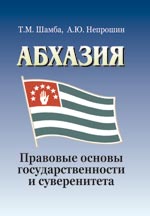
Shamba T., Neproshin А. Abkhazia: Legal basis of statehood and sovereignty. М: Open Company "In-Oktavo", 2005, 240 pages.
Далее читайте:
Абхазы -
(самоназвание апсуа) автохтонное население Кавказа.
Абхазия
(краткая историческая справка).
Исторические лица Абхазии (биографический справочник).
|
