|
|
Abkhazia
Legal basis of statehood and sovereignty
Chapter 3. Legal basis of statehood
3.4. Statehood and the sovereignty of Abkhazia
Statehood is a special feature by which historical development of a country
is noted, with a people who were able to create their own state or to restore a
state lost owing to various reasons. It not only the property of a society and
an indicator of its development. It is an ideology, and the public, political
and cultural orientation directing the people towards development of the state,
its protection, etc. As V.V. Ilyin notes in “Political science”, the basic
symbolic signs of statehood are the use of an official state language, state
emblems (the arms, a hymn, a flag) and specific forms of the state (political)
organisation of a society: forms of government, a political system, political
relations, power structures etc. The problem of development of statehood is
always acute, especially in transition periods of formation of states that
were connected with the disintegration of empires and state unions. Abkhazia
has already passed this way.
World experience in building states has revealed a number of the major
factors in their legitimate formation and existence. These are: presence of a
direct connection of the people with territory of residence, i.e. the
right of the people to the given territory; aspiration of the people to
political self-determination, i.e. to the formation of public authorities;
ability of the people to provide the functioning of the state. All these factors
are present regarding the Abkhazian state. As S.Shamba states in his work “To a
question on a legal, historical and moral substantiation of the right of
Abkhazia to independence”, the Abkhazian state – which existed for twelve
centuries, and was recreated in the 1990s - is formed by the Abkhazian people on
their native land, and it independently and successfully functioned under
various historical conditions. During its development the Abkhazian statehood
changed its form and content, at times weakening to the lowest level and even
being interrupted, but never disappearing from the consciousness of the
people.
The political desire of the Abkhazian people to maintain sovereignty,
expressed in numerous actions throughout the centuries, always was and still
remains the pledge of existence of their state. Acceptance by Georgia of
decisions which disavowed earlier operating official state documents has
essentially facilitated work on demonstratively revealing the presence
of the necessary conditions confirming the statehood and sovereignty of
Abkhazia. As was earlier noted, the documents accepted by Georgia during the
period from May 26th, 1918 to the termination of the Georgian occupation in
1921, and also during the following years, were insignificant from the very
beginning, invalid, and had no legal power. They should be disavowed by
the government of the Republic of Abkhazia, which would lead to the restoration
of the initial status of the country (restitutio in integrum).
Abkhazia not only struggled for preservation of the USSR, and for its
integrity, but wished to remain within it. This relationship was maintained up
to the end, even when the Soviet Union was threatened with the danger of
disintegration. But the centrifugal force of reorganisation and perestroika
grew, and Abkhazia was the last to depart from the USSR. The forces which really
united these countries were their proximity, both overland and by sea, the close
unity of their Slavic horde and the Caucasian people, the historical association
of their separate groups, their mutual gravitation to each other, and their
interlacings of spiritual and economic interests. Too many vital threads,
material and spiritual, were stretched between them.
The thesis about “the right of the people to self-determination” is
constantly forgotten by politicians and government officials. This firstly
concerns the United Nations, the OSCE and so on, which define the development of
interstate relations. Irrespective of any decisions made by different
governments or international organisations, Abkhazia has every basis and right
to insist on the restoration and recognition of its full independence.
In fundamental research into the circumstances leading to loss of
sovereignty, such as occupation and annexation of the state, V.Chernichenko
shows that such characteristics as personality, the legal validity of the state,
and sovereignty are closely connected with each other. Thus “the personality of
the state” is understood as the role played by government personnel in the
country and their position in defining state policy i.e. the personality of the
state is defined through the realisation of a vector of the wills of separate
representatives of the state and of social groups.
In a period of full occupation of the country, even if the state perishes,
losing its personality, it keeps its legality, as the territory of the country
and its population remain as subjects of international law, even after loss of
statehood. If the people, being a source of the state sovereignty, remain, it
is considered that the state sovereignty, as well as its legality de jure also
remain. In this case the state de facto loses only its capability to function,
because the society which generated this state remains, and upon the approach
of favorable conditions the roots of the state will produce new shoots. It is
easy to destroy state structures by occupation, more difficult to destroy
economic interrelations, and impossible to destroy the spiritual aspect
of a society and its culture. This thesis is confirmed in practice by the
evolution of the Abkhazian state, which was subjected to military, economic and
other expansion by Georgia during the period from 1918 to 1993. It testifies
that even the long period of loss of the personality of the state and its
international legal validity (as well as its “revival”) depends on both
objective and subjective factors.
At the same time the fact of occupation does not mean, in the opinion of
V.Chernichenko, any transfer of sovereignty to the occupying party. Moreover,
the state whose territory is occupied is formally considered as keeping
its sovereignty de jure, as well as its international legality. This is the
conventional position of international law, i.e. the imperative norm. Loss of
legality, according to classical international law, can take place only after
a formal acceptance of annexation. If a national liberation struggle by the
use of political means proceeds, the national resistance force and allies of
the annexed country do not recognise annexation, and continue the struggle for
its liberation. The question can remain in a condition of legal uncertainty
for many years, as has taken place in the case of Abkhazia. As annexation is
defined in current international law as an illegal action, any document
supporting it, from the point of view of the international community, has no
validity and does not lead to loss of the sovereignty of the state or to loss of
its legality.
In our work we have shown that all activity of the Georgian government
regarding mutual relations with Abkhazia has always been directed towards the
destruction of the stability and integrity of that state. These actions
concern: military expansion of Georgia into Abkhazia, occupation of the country,
the attempt at annexation proceeding throughout more than 70 years, illegal
resettlement of the Georgian population from the mother country into Abkhazia,
and genocide in relation to Abkhazians. The purpose of these actions has been
to create a superiority in strength of the Georgian enclave by changing the
demographic situation in Abkhazia, having carried out the conversion of the
indigenous population of Abkhazians into a small nationality, with appropriation
of their territory and its inclusion within the structure of Georgia.
The retrospective recognition of the annexation of Abkhazia as void and
wrongful means that although it was not earlier considered illegal, it is now
recognized as legally nonexistent, and so are its legal consequences, so its
actual consequences should be removed. But for many countries, subject to
annexations, the full and real implementation of this postulate is impossible.
As for Abkhazia, its life, development and the evolution of history promoted its
exit from the condition of annexation. The reason for this was first of all the
disintegration of the Soviet Union, and then the legal actions of the country’s
leaders to create an independent state – the Republic of Abkhazia.
The essential basis for recognition that the annexation of Abkhazia by
Georgia was illegal is that, as shown in our work, the annexation of the country
occurred after legal confirmation of the fact of formation of the Abkhazian
nation, people and national state, which had already been recognised by the
Russian empire in 1810, and this fact is confirmed by the corresponding
international agreement.
We believe, that the listed facts, supported by legal documents (facta
concludentia), are enough to draw a legal conclusion.
Attempts to solve the problem of restoration of the sovereignty of Abkhazia
began at once after the termination of the occupation of Abkhazia by Georgia in
1921. A partial success was achieved. Abkhazia was an independent republic
until 1922, and then again started to lose its sovereignty. Work on the
restoration of its sovereignty was especially intensive upon termination of the
Georgian-Abkhazian war of 1992-1993, followed by termination of the Georgian
annexation. Though Abkhazia established its own Constitution declaring its
sovereignty, the international community and neighbours in the CIS did not
support such a decision and did not recognise it. The General Assembly of the
United Nations accepted on November 17th, 1989 the resolution 44/23 about the
declaration of the 1990s as “Decade of international law”, but during all this
time it could not or did not want to solve the question of the sovereignty of
Abkhazia, or to punish Georgia for continuous actions of military extremism and
aggression in relation to Abkhazia.
The reason for that is the superficial approach to the problem of mutual
relations between Abkhazia and Georgia. The history of Abkhazia, as well as of
other countries which were or are in a similar situation, confirms that the
decision of the problem rests with the granting of sovereignty to countries
dependent on other states. As for Abkhazia, as shown in our work it has
historically remained an independent state throughout two millenia, possessing
all the necessary features and attributes of sovereignty recognised today by
the world community. It demands only one thing, that the international community
should confirm and legitimise this sovereignty in the same way as it has done
for other states in a similar situation. It is also necessary to remember that
Russia, leaving the structure of the USSR having accepted its debts and
obligations, has left alone all states within the administrative structure of
the USSR, having given them the opportunity to develop and build their countries
in their own way, and thus having confirmed that the territory of the USSR is
not the territory of Russia. Also, the independent Georgian state became the
successor to the Georgian Soviet Socialist Republic, having forgotten that its
assignment extends only to territory which is actually Georgia. Abkhazia, which
entered the Soviet state under special conditions as a part of the Georgian SSR,
is not a part of Georgia, either in an ethnic, territorial, or administrative
capacity. The territory of the Georgian Soviet Socialist Republic and the
territory of Georgia are different concepts. International law in this situation
has a firm position - nemo ex suo delicto meliorem suam conditionem fasere
potest - nobody can improve their position by breaking laws.
Hence, the sovereignty of Abkhazia was defined and confirmed as a result of
the disintegration of the USSR and its reallocation, together with further steps
towards finding independence, including the self-determination of the country on
the basis of a referendum. Due to the form of recognition, Abkhazia de facto and
de jure is the subject of international law, and we hope that time will put
everything in its right place.
Being the subject of international law, Abkhazia has restored its sovereignty
as a state formed as a result of the division of the Soviet Union,
leaving it with its indigenous population of Abkhazians living in the territory
historically belonging to them. Thus all states of the world have been
notified of the assignment of the government and the people of Abkhazia to the
state and the territory.
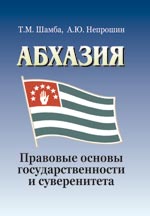
Shamba T., Neproshin А. Abkhazia: Legal basis of statehood and sovereignty. М: Open Company "In-Oktavo", 2005, 240 pages.
Далее читайте:
Абхазы -
(самоназвание апсуа) автохтонное население Кавказа.
Абхазия
(краткая историческая справка).
Исторические лица Абхазии (биографический справочник).
|
