|
|
Abkhazia
Legal basis of statehood and sovereignty
Chapter 3. Legal basis of statehood
3.8. Prospects of a decision to the problem
International public law says: at the moment of destruction of a former
state system (which the Soviet Union was) and with the organisation of a new one
(the Republic of Abkhazia), when the old power concedes reins to the new
government, and if this separation process is finished and confirmed by the
national will of the people, with a recognition of independence by other
governments de facto, all previous agreements and treaties lose their validity.
Actually, the newly appeared sovereign state initially inherits the recognized
rights and duties of a subject of international law, and then acquires new ones
(clausia rebus sie stantibus).
With the disintegration of the USSR, the status of Abkhazia as a state was
changed, and all international treaties were automatically invalidated owing to
this, or to the special statement that corresponds to item 16 of the Viennese
convention on the assignment of states concerning treaties, from August
23rd, 1978:
“A new independent state is not obliged to keep any treaty in force, or to
become its participant, simply because of the fact that at the moment of state
assignment this treaty was in force concerning the territory which is the object
of the assignment of the states”.
As to the problem of international recognition of the independence of
Abkhazia after the disintegration of the USSR and creation of the Commonwealth
of Independent States (CIS), it is necessary to note that by 1990 the statehood
of the Transcaucasian republics had not been formed according to the laws
concerning the formation of the CIS, though attention was directed to the
question of revival of the updated union and on the possibility of
self-determination of each nation. The form of the new states was also not
defined. Thus Georgia as a sovereign state should not have received recognition,
as any decisions concerning the priorities of one nation affected the interests
of others. Various obligations of international documents have legal abilities
to form one indissoluble whole, and the parts concerning Abkhazia and its
sovereignty should not have been separated from other parts of the same
treatise. But the world community, pursuing its aims of the quickest
disintegration of the USSR, shut its eyes to this essential infringement of
international law and quickly recognised the sovereignty of Georgia.
We should notice that the deadlock which Abkhazia has reached in its attempts
to restore its sovereignty was created by an information war. It is clear that
this has been planned by the Georgian government, which in every possible way
tries to convince the international community about discrimination against the
Georgian people making the majority of the population of the country in
Abkhazia. Dear reader, think about that twaddle - there are 95 thousand people
now representing the Abkhazian ethnos, who have gone through genocide from
Georgia throughout almost a century, and been subjected to discrimination by the
Georgian part of the population of Abkhazia, which was 250 thousand people.
As well as this, all managerial posts in the country belonged to Georgians, and
a policy of Georgianisation of the language, culture and consciousness of
Abkhazians was followed, controlled by the KGB, the Ministry of Internal Affairs
and the Army i.e. the power structures which were under the full control of
Georgia. Nothing but gibberish!
It is amazing that the Georgian view is supported by the international
community in the name of the United Nations, the CSCE, etc. Even the most simple
question - a recognition of the act of aggression by Georgia in relation to
Abkhazia which was the victim, has not been solved. The Security Council, into
whose duties enter official confirmation of the fact of aggression, cannot and
does not do this concerning Abkhazia, and simply does not prosecute the
aggressor. In the case of a possible consideration of a question on the act of
aggression, someone from the members of the Security Council can always use a
veto, but after all this will not change features of the act of aggression
representing intervention of the state in affairs of another with intention to
force the other state to operate according to its will.
We wish to show an interesting document clearly characterising double
standards in the politics of Georgia and the inconsistency of its claims to
Abkhazia. In the left-hand column we provide the full text of “the Statement
about restoration of the state independence of Georgia”, in which the Georgian
government proves the requirements for a recognition and restoration of the
sovereignty of the country, and furnishes convincing proofs in favour of its
recognition. In the right-hand column we have placed only some parts of actual
and legal proofs stated by us in the present work, and have entered them into
the text of the above Statement, but having shown the given items
relating to Abkhazia. The Abkhazian government, unfortunately, has not prepared
a similar document, therefore we will dare to execute it for them.
Simultaneously, in italics we will note discrepancies and distortions, not
affecting any validity, which occur in the Georgian original of the Statement.
|
The statement about restoration of the state
independence of Georgia
The statehood of Georgia originating in the heart of centuries
(Pure lie! Statehood of "Georgia" never existed till 1918, and
so there was nothing to restore. Speech can be only about
Kartli-Kakhetia which Russians named Georgia at end of ХVШ
century - authors) was lost by the Georgian people in XIX century, owing
to the annexation of Georgia carried out by Russian empire and
abolition of its statehood (According to the Georgievsk treaty and the
Manifesto of 1801, governors of Kartli-Kakhetia asked about
inclusion of these princedoms in structure of Russian territory on
Caucasus, as was received, therefore to speak about annexation
is not truthful.) The Georgian people were never reconciled with loss
of freedom. On the basis of the Statement about independence of May
26th, 1918 the abolished statehood of Georgia was restored
and the Georgian Democratic Republic with its Constitution and
representative bodies elected on the basis of a multi-party system
was formed.
In February - March, 1921 Soviet Russia, roughly having
broken the peace treaty concluded between Georgia and Russia on May 7th
1920, by armed aggression occupied the Georgian state recognised
by it, and then carried out its actual annexation.
Georgia was included into structure of Soviet Union
involuntarily, and its statehood was restored (originated - authors)
in 1918, and exists today. The statement about independence of
Georgia and its Constitution have validity today as
the government of democratic republic did not sign the document about
capitulation and continued activity in emigration.
All period of violent stay of Georgia as a part of the USSR is noted
by bloody terror and reprisals, last display of that was the tragedy
on April 9th, 1989. The latent war against Georgia proceeds today,
its purpose - to prevent aspiration of Georgia to freedom and
democracy.
The Republic of Georgia Supreme Council, elected on October 28th,
1991 on the basis of multi-party, democratic elections, following the
will of the population of Georgia, unanimously expressed by it in a
referendum on March 31st, 1991, decides and for the whole world
proclaims restoration of the state independence of Georgia on the
basis of the Statement about independence of Georgia of May 26th,
1918.
|
The statement about restoration of the state independence of
Abkhazia
The statehood of Abkhazia originating in V century BC, was lost by
the Abkhazian people in XIX century, owing to the annexation of
Abkhazia carried out by Russian empire and abolition of its
statehood. The Abkhazian people were never reconciled with loss of
freedom. On the basis of the Allied treaty of October 20th, 1917 the
abolished statehood of Abkhazia was restored through its introduction
into the Southeast Union of the Cossack army, Mountaineers of Caucasus
and the free peoples of Steppes. Congress of the Abkhazian people
accepted on November 8th, 1917 the Constitution of Abkhazia and
elected the Government - the Abkhazian National Council.
In May - June, 1918 the Georgian Democratic Republic, roughly
having broken the Agreement from February 9th, 1918, by armed
aggression occupied the Abkhazian state recognised by it, and then
carried out its actual annexation.
Abkhazia was included into structure of Georgia involuntarily,
and its statehood was restored in 1917, and exists today. The
statement about independence of Abkhazia and its Constitution have
validity today as the government of democratic republic did not sign
the document about capitulation and continued activity in the
conditions of an occupation regime.
All period of violent stay of Abkhazia as a part of Georgia is
noted by bloody terror and reprisals, last display of that was
the tragedy on August 14th, 1992. The latent war against Abkhazia
proceeds today, its purpose - to prevent aspiration of Abkhazia
to freedom and democracy.
The Republic of Abkhazia Supreme Council, elected on October 28th,
1991 on the basis of multi-party, democratic elections, following the
will of the population of Abkhazia, unanimously expressed by it in a
referendum on March 17th, 1991, decides and for the whole world
proclaims restoration of the state independence of Abkhazia on the
basis of the decision of the first Congress of the Abkhazian people
which took place on November 8th, 1917, on which the country Parliament
(Abkhazian National Council) was elected and defined its main task as
work on self-determination of the Abkhazian people, and also,
according to decision of Orgburo RCP (b) and Revcom Abkhazia from
March 31st, 1921 which declared Abkhazia as Independent Soviet
Socialist Republic.
|
|
The territory of sovereign Republic Georgia is uniform and
indivisible. In Republic Georgia territory the Constitution and the
Republic Georgia power have command only. Any action directed on
restriction of leadership of the power of Republic Georgia or
infringement of its territorial integrity, will be qualified as
intervention in internal affairs of the sovereign state, and
aggression as rough infringement of international law.
Primacy of international law concerning laws of Republic Georgia and
direct action of its norms in territory of Georgia are one of the
basic constitutional principles of Republic Georgia.
The republic Georgia, aspiring to take a worthy place in
commonwealth of the states of the world, recognises and equally follows
all fundamental laws provided by international law, and provides freedom
of the person, national, ethnic, religious and language groups as
demanded by the United Nations Organization charter, the General
declaration of human rights, and international pacts and conventions.
(Simultaneously being Aggressor, source of violence and genocide, and
the cause of the international pressure in Transcaucasia).
The Republic Georgia Supreme Council declares that it will firmly
observe the standard principles of political, economic and cultural
cooperation with other states.
Restoration of the state independence of Republic Georgia
completely corresponds to the United Nations Organization charter, the
Helsinki and Viennese statements recognising and fixing the right of
all people independently to define political destiny of the country.
The Republic Georgia Supreme Council hopes that the international
cooperation of the states does not remain indifferent to lawful
and fair steps of the Georgian people and recognises the revived
state independence of Georgia that is one of the firmest guarantees of
safety of Republic Georgia.
Signed by members of the Supreme Council
and the Republic Georgia government.
Tbilisi,
April 9th, 1991.
12.30 am.
|
The territory of sovereign Republic Abkhazia is uniform and
indivisible. In Republic Abkhazia territory the Constitution and the
Republic Abkhazia power have command only. Any action directed on
restriction of leadership of the power of Republic Abkhazia or
infringement of its territorial integrity, will be qualified as
intervention in internal affairs of the sovereign state, and
aggression as rough infringement of international law.
Primacy of international law concerning laws of Republic Abkhazia
and direct action of its norms in territory of Abkhazia are one of the
basic constitutional principles of Republic Abkhazia.
The republic Abkhazia, aspiring to take a worthy place in
commonwealth of the states of the world, recognises and equally
follows all fundamental laws provided by international law,
and provides freedom of the person, national, ethnic, religious and
language groups as demanded by the United Nations Organization charter,
the General declaration of human rights, and international pacts and
conventions.
The Republic Abkhazia Supreme Council declares that it will firmly
observe the standard principles of political, economic and cultural
cooperation with other states.
Restoration of the state independence of Republic Abkhazia completely
corresponds to the United Nations Organization charter, the
Helsinki and Viennese statements recognising and fixing the right of
all people independently to define political destiny of the country.
The Republic Abkhazia Supreme Council hopes that the international
cooperation of the states does not remain indifferent to lawful and
fair steps of the Abkhazian people and recognises the revived state
independence of Abkhazia that is one of the firmest guarantees of
safety of Republic Abkhazia.
|
| |
|
There is a fair question, which is on what basis has Georgia, making all
conceivable and inconceivable infringements of the norms of international law,
been recognised as a sovereign state? And why cannot Abkhazia, possessing the
same if not more powerful arguments in favour of its sovereignty, find the
freedom and rights which it deserves and for which it has all historical and
legislative grounds?
Also, though the obvious does not require proof (manifestum non eget pro-batione),
Abkhazia, given the position of the United Nations and the CSCE, will not be
able to receive a fair decision from the international community. In our
opinion, the only way to reach a positive decision in this matter is to knock on
all doors and to prove the truth by means of legally convincing arguments. We
hope that the present work will make a contribution towards untying this
tightened knot.
The ethnic conflict which took place in Abkhazia throughout XX century was a
consequence of the presence of sharp national contradictions resulting from the
strong dependence of the Abkhazian people on the ethnically alien Georgian
state, and on subjective actions by the persons who were at the head of this
state and its forces, and the policy followed by them. Such actions of the
state, in relation to the Abkhazian ethnos, as genocide, deportation,
various sorts of national infringements and restrictions (language, culture,
the government) were indefensible. But this is the roughest infringement of
international public law, as it appears the hostage of actions by private
persons (Jus publicum privatorum'pactis mutari non potest). As an ethnos is a
system of interconnected elements, any restriction to one of them (and
furthermore to several simultaneously) will inevitably demand the restoration
of these elements through a system of connections with a different community,
and this leads to the ethnos replacement that is called genocide.
We cannot be judges of our own case (пето index in causa sua), therefore we
believe that for the definitive decision of this problem it is necessary to
transfer the process of its consideration by international organisations into a
legal channel and to start to work in a legal field defined by these
organisations. The international community provides a complex of legal means
for the peaceful solving of international disputes, namely: direct
negotiations, intermediaries, the resolution of disputes by international
organisations. In our opinion, the most effective solution could become the
international investigatory procedure (inspection) i.e. investigation by an
international body ( the international court or international
arbitration) of the concrete circumstances and the fact sheet underlying the
international disagreement. Though the conflict has reached a deadlock phase, it
makes sense to again address those who will allow an investigation of its root
causes by using legal means available to their organisation’s legal department.
In this case there will not be inexpedient use of a solely historical approach
in an estimation of possibilities of confirmation of the sovereignty of
Abkhazia. Both parties should present their demonstrative data on the basis of
legal documents concerning this question. In the final instance, there should be
an international court or other impartial proxy body able to make a
corresponding decision. Transfer of consideration of the question of sovereignty
to a legal environment will outline at once the limits of consideration of the
problem and will define the borders of use of legal documents as arguments by
the contradictory parties.
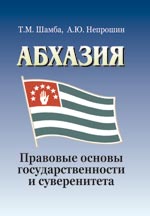
Shamba T., Neproshin А. Abkhazia: Legal basis of statehood and sovereignty. М: Open Company "In-Oktavo", 2005, 240 pages.
Далее читайте:
Абхазы -
(самоназвание апсуа) автохтонное население Кавказа.
Абхазия
(краткая историческая справка).
Исторические лица Абхазии (биографический справочник).
|
