Abkhazia
Legal basis of statehood and sovereignty
Chapter 2. Statehood of Abkhazia
2.5. Soviet Abkhazia - the sovereign state
Under the conditions of Georgian occupation the Abkhazian people rose to an
armed struggle which had the character of a national liberation. Achievement
of this purpose was assisted by the approach of the Red Army and the
establishment of Soviet power in the states of Transcaucasia. It is natural
that in this situation the interests of Moscow and the Abkhazian national
liberation movement coincided. In Abkhazia Soviet power was established on
March 4th, 1921. At a meeting of ranking officers of Abkhazia the question of
the country’s future was considered, and delegates unanimously
voiced the same opinion:
a) Abkhazia should be declared a Soviet Socialist Republic;
b) Soviet Abkhazia should enter into the all-Russian federation directly;
c) The general policy in Abkhazia should be of moderate caution in relation
to the bourgeoisie and peasantry.
At a mass meeting in Sukhum on March 8th, 1921 the following resolution was
accepted, and later directed to V.I.Lenin:
“Today the workers of Abkhazia who were exhausted under the heavy yoke of
autocracy from Georgian Mensheviks, footmen of imperialists, celebrate their
freedom, welcome the Red Army which has come to the aid of the insurgent
people of Abkhazia, and send warm greetings to the leader of world proletariat,
comrade Lenin... and to the staff of the world proletarian revolution - the
Third Communist International. The chairman of the Revcom of Abkhazia, E.Eshba.
Note by E.Eshba: From all settlements in Abkhazia, salutatory resolutions are
sent from farmers’ meetings. Workers enthusiastically welcome the Red
Army”.
On the basis of this resolution only, it already becomes clear what the
relation of the Abkhazian people to the Georgian invaders was during annexation
of the country by Georgia in 1918-1921, and also how the force was defined which
after the difficult years of Georgian enslavement rallied the people of Abkhazia
to beat out their aggressors beyond the limits of the native land.
Being guided by the Declaration of the rights of the people of Russia, on
March 26th, 1921 at an expanded session of the Organisation Bureau (orgburo) of
the RCP(b) and Revcom of Abkhazia it was decided to declare Abkhazia a Soviet
Socialist Republic. The independent Soviet Socialist Republic of Abkhazia was
proclaimed on March 31st, 1921. The report of the Batumi meeting on the
structure of Soviet power and the Communist Party in Abkhazia said:
“Heard: about the structure of Soviet power and Communist Party in Abkhazia.
Decided: until the Congress of Councils of Abkhazia, the question of a
federation of Soviet Abkhazia with Russian Soviet Federative Socialist Republic
(RSFSR) or the Soviet Socialist Republic of Georgia (GSSR) is left open, and
Abkhazia is declared a Soviet Socialist Republic.
The party organisation before the conference carried the name orgburo of RCP
in Abkhazia and worked under the direction of the Caucasian bureau of the
Central Committee of RCP. Orgburo took necessary measures to overcome national
hostility sown by Mensheviks between the people of Georgia and Abkhazia”.
On May 21st, 1921 the Revcom of the GSSR recognised the independence of the
Soviet Socialist Republic of Abkhazia (ASSR) and accepted the Declaration of the
Revcom of GSSR on the independence of ASSR. We show items from the text of this
document:
“Menshevik power, being in essence the power of the Georgian bourgeoisie,
along with oppression of workers in Georgia, with especial force suppressed any
display of revolutionary activity by national minorities, which created terrible
antagonism among different nationalities in Georgia, nationalities living in
this territory from time immemorial.
Soviet power replaces oppression by equality and the brotherly union of all
workers without distinction of nationalities. The unique true means of
overcoming national prejudices and strengthening the rightful union of workers
is the right of nations to self-determination, as proclaimed by the Great
October revolution.
Proceeding from this, the Revolutionary Committee of the Soviet Socialist
Republic of Georgia recognises and welcomes the formation of the independent
Soviet Socialist Republic of Abkhazia... Revcom of the Soviet Socialist Republic
of Georgia”.
However, danger of an encroachment by Georgia on the sovereignty and
territory of Abkhazia remained. This was understood both by politicians of
free Abkhazia, and emissaries of the government of RSFSR, who saw in Abkhazia
not only a problem of mutual relations of two neighbouring countries, but also
an interlacing of interests of the Entente countries, as well as a question of
international policy in the broad sense. As an example, we give the following
report:
From P.P.Sytin's report to the Soviet government “Measures of localisation of
danger from Georgian chauvinism” on April 22nd, 1921:
“Undoubtedly, it is necessary to approach this question cautiously, but it is
impossible to make the essential interests of the International a victim of the
chauvinism of a small nation taking such an important territorial position (as a
gateway to India) between RSFSR on the one hand, and Turkey and the Entente on
the other... It should not be forgotten that the diplomacy of the Entente, which
has met persistent counteraction to its imperialist plans from Soviet Russia,
looks at Georgian chauvinism as one of its integral chances in its struggle
against Soviet Russia, especially if the Entente will be able to reach agreement
with Turkey. To defeat Germany and Russia, the Entente has already made
concessions and, wishing to break the unity of its enemies, has selected a line
of least resistance, i.e. Turkey, caressing in every possible way its
nationalist dreams of full restoration of the Caliphate with Constantinople at
its head. Payment from Turkey must be its betrayal of Russia. Confrontation on
this issue is rather probable, and as this could occur in the territory of
Georgia this territory is becoming of major strategic value.
Thus, keeping enough strong groups of the Red Army of RSFSR within Georgia,
and especially along the southern coast of the Black Sea and on the border
with Turkey, should be one of the precautionary measures against local
chauvinists, these measures also having a general political character....
The second measure weakening Georgian chauvinism, both territorially and
financially, I would consider to be the separation of Abkhazia. It is necessary
to confess that, as earlier in the Armenian question, Russia’s error in ignoring
the Kurds could always be seen. We will note, by the way, that in Turkish
Armenia it would be quite possible to involve Kurds on the Russian side. After
all, Kurds have never considered themselves as citizens of the Turkish sultan,
and have always hated Turkish administration... The Soviet power has many
chances to win people round, and Georgians have paid little attention to
Abkhazia. Hardly anybody is interested in the sad destiny of these two peoples
being wiped off the face of the earth by the chauvinism of Armenians and
Georgians. The certain gravitation of Abkhazians to Soviet Russia has been
well considered by Georgian Mensheviks and for this reason they have
artificially separated Abkhazia from directly bordering with Russia, having
occupied a small coastal strip to the north of the river Bzyb. It is necessary
to immediately move the border of RSFSR to the right coast of the Bzyb, i.e. to
the immediate vicinity of Abkhazia. If a question on the desired form of their
state is put to the Abkhazian people, for example by plebiscite (it is possible
to organise this in a very short time), there is no doubt they will take the
decision to fully join with RSFSR, and such an action, in addition to its huge
strategic and political value for RSFSR, will transfer into Russian hands the
huge national riches of this country currently ruined by Georgians. Even if it
is Soviet, Georgia itself (or especially Abkhazia alone), will never cope with
the problem of the correct exploitation of the huge wood and mountain resources
of this country, or even with the correct organisation of tobacco production,
fisheries etc.
On population structure, Abkhazia cannot be under the authority of Georgia at
all, because they (Georgians) are least in the total of inhabitants...
The separation of Abkhazia cannot adversely affect the foodstuffs of Georgia
as one sometimes has to hear, because Abkhazia, plentiful with natural riches
(till this moment almost unused, because only RSFSR has enough power to do it),
hardly feeds itself...
After Abkhazia, it is necessary to pay attention to Mingrelia, a country also
differing from Georgia in language and nationality and always burdened with
Georgian sovereignty. Mingrelia directly borders Abkhazia on the river Ingur and
stretches south to the river Rion. This territory includes the mouth of the
river Rion, at which the building of a big port, able to replace Batum, has
been projected for a long time... the territory is extremely big in strategic
relations, and also can be subordinated to the direct influence of RSFSR if, as
with Abkhazians, autonomy will also be given to Mingrelians...
This created position will probably be found to address one measure, namely:
the strong seizure by RSFSR of the Transcaucasian railways, and not only in the
sense of military protection but also concerning management, as in this last
sense the underlined exaggeration of the value of narrow Georgian interests
brings huge damage to Russia...”.
Independence was also received by other states of Transcaucasia. However,
the central party leaders forced rigid submission to their influence and
decisions, the states having accepted the corresponding document:
From the resolution of a meeting of the Caucasian Bureau of the Central
Committee of RCP(b) on 2nd-3rd July, 1921, about the political position of the
Transcaucasian republics:
“1. To admit the necessity of confirming the independence of the Caucasian
republics (Georgia, Azerbaijan, Armenia), with the unconditional preservation
of existing party relations between Central Committees of Communist Parties of
these countries and the Central Committee of RCP”.
Using the slogan of Soviet power "Authorities should be local", Revcom of
Abkhazia became the full owner of the country, and gave the necessary political
and economic rights to the indigenous population. The Abkhazian intelligentsia,
having believed in the independence of the country promised by Bolsheviks,
supported this power. An economic upsurge in the country began at that moment.
After the declaration on March 31st, 1921 of the independent Soviet
Socialist Republic of Abkhazia (the SSR Abkhazia) and its recognition on May
21st, 1921 by Revcom of Georgia, “the Workers' and Peasants' Union Treaty
between the Russian Soviet Federal Socialist Republic and the Socialist Soviet
Republic of Georgia” was concluded that very day. This treaty had no relation to
SSR Abkhazia, which was not mentioned in it at all, thus confirming the
sovereignty of Abkhazia and its independence from Georgia in the spring of
1921.
With the initiative of Georgian national chauvinists both in Georgia
and in Abkhazia, intensive propaganda activities directed towards the formation
in the country of a pro-Georgian atmosphere, with the purpose of creating
favourable conditions for the joining of Abkhazia to Georgia, again began. In
the press there were articles proving the political, economic and cultural
unsoundness of Abkhazians as a nation and Abkhazia as an independent state.
From correspondence to the newspaper "Socialist-Federalist" about
discrimination against Georgians in Abkhazia:
“Many new events have occurred in Abkhazia after the establishment of Soviet
power. It is known that the so-called “independence of Abkhazia” was declared
here, which in practice means the establishment of domination by Russians. It is
completely impossible to describe the orgy reigning here. Russian politicians,
"admirers" of Abkhazians, and some persons who have fallen in love with Russia,
having all become privileged, have presented “the independence” of Abkhazia
as hatred of Georgia...
Almost all posts are occupied by Russians. Georgians suffer from prosecution
and oppression. The words "Georgia" and "Georgian" have been transformed into
abusive terms”. ( the signature “Sukhum Georgian”).
From the report in the newspaper "Socialist-Federalist" on E.Eshba's meeting
with the public of Gali district about local population requirements, July 20th,
1921:
“Eshba’s answer, that for the Bolshevik party the question of an addition of
Abkhazia to Russia or to Soviet Georgia is unimportant, did not satisfy the
public. At the meeting propensity towards the union with Georgia was obviously
shown. It is necessary to note one fact which caused a big protest. After
Eshba had answered questions, a certain Jason Agumava spoke, and started to
prove to those present that the native language of Samurzakans is ostensibly
Abkhazian, and therefore demanded introductory training in elementary schools in
the Abkhazian language; all the meeting unanimously declared their protest to
the impudent speaker”.
From P.Mirianashvili's article “Apropos the “independence” of Abkhazia”:
“The Abkhazian separatists motivated their isolation, and separation from
their native brothers, by considering that they ostensibly were not Georgians...
Abkhazian national statehood did not exist yet, and neither did any Abkhazian
national culture. We considered and consider nowadays the possible creation of
Abkhazian national culture without a declaration of independence... The rescue
is unity with Georgians, with Georgia”.
From correspondence in the newspaper “Socialist-Federalist”:
“The party in power should at least now rectify this error, and remind the
Revcom of Abkhazia that independence was then the means of freedom from
Mensheviks and introduction of the Soviet system within Abkhazia. Well, the
independence of Soviet Abkhazia from Soviet Georgia is not now meaningful, and
is rather harmful to both parties. We will look at what arguments will be put
forward after that by leaders of Abkhazia in favour of independence.
We know that Abkhazians differ from other Georgians in their features,
customs, belief and language.
We are deeply sure that a wide autonomy will quite satisfy the labour
peasantry of Abkhazia, and whoever demands more should firstly ask the
people”.
From V.Kotetishvili's article “To the integrity of Georgia” in the newspaper
“Socialist-Federalist”:
“Today we wish to call the attention of the working people of Georgia to
“independent Abkhazia” where dubious persons develop old methods and sow rage
to the detriment of Georgia.
And in such a corner, by what right can any "politicians" subordinate the
majority? What reasons justify such impudent behaviour? Who has so
inconsiderately granted the right to appropriate the larger part of the Georgian
land? In the "Abkhazian" alphabet they have published a newspaper... Is this the
independence of Abkhazia? Is it self-determination? Is it demanded by the
working people of Abkhazia? No... Abkhazia both ethnically and linguistically,
both historically and culturally, is a part of Georgia, and its question should
be decided on the scale of Georgia, at the will of the working people of all
Georgia.
Do not give the chance to the regenerated Abkhazians and Georgians to conduct
any wild policy which will give a bad fruit for the territorial integrity of
Georgia, for its national existence! In the interests of the working people we
resolutely demand to clear Abkhazia of a different sort of adventurers. We
demand to cancel the Declaration written somewhere in an "office" on the
"independence" of Abkhazia and to reestablish live communication and the
integrity of our country”.
Under this pressure and with a change of policy of the central party leaders
in Moscow, pressure upon Abkhazia was deliberately increased with the aim of
incorporating it within the structure of Georgia. Leaders of the country, being
in an ambiguous situation, started to incline towards this idea. Being
Abkhazians, they were obliged to carry out the will of the people. But as
representatives of the multinational people of Abkhazia, there was a continuous
Georgian influence on them both from within and from the outside. But most
importantly, submitting to instructions from the central office of the Bolshevik
party, they were obliged to carry out its decisions which contradicted the
national policy and selfconsciousness of Abkhazians. It was a tragedy for the
government of Abkhazia. The evidence for the above is contained in texts of
speeches by the leaders of the country.
From a speech at the meeting of ranking officers of Abkhazia on July 23rd,
1921:
“... N.Lakoba has specified the necessity for a federal union between Soviet
Abkhazia and Soviet Georgia owing to their ethnography, history and
common way of life, and has also specified that Abkhazia cannot have a federal
union with Soviet Russia because it is lagging behind Russia by four years.
Besides, Soviet Georgia and Abkhazia are independent economically but in
political terms they submit to the centre through RCP in the name of the Central
Committee of the party of Georgia and Caucasian bureau of Central Committee of
RCP; that is why it is absolutely irelevant whoever Abkhazia will have a federal
union with, the fact is to keep the idea of the Soviet power”.
From the report of the Chairman of the Council of National Commissars (CNC)
of Abkhazia, N.Lakoba, at the third session of the All-Georgian Central
Executive Committee in Sukhum on June 13th, 1926:
“Some people understand the Abkhazian republic in the sense that the
Abkhazian republic is the republic for Abkhazians. Such a situation does not
correspond to the reality of business in Abkhazia and this is why: though we are
called Abkhazia, in Abkhazia we deal not only with Abkhazians.
Here the main peoples, by their numerical weight, are the following:
Abkhazians, Georgians, Armenians and Greeks. But the Abkhazian should not argue
thus: if I was oppressed earlier more than others, I now have the right to more
freedom, and to more privilege in comparison with other nationalities.
... Some of our opponents always build their tactics on the weakening of the
government of the republic of Abkhazia thus: Abkhazia will leave Georgia if it
wants, will remain with Georgia if it wants... From Soviet Georgia, Soviet
Abkhazia is not going to leave for anywhere, but together with Soviet
Georgia, as a part of Soviet Georgia, Abkhazia will go, even to the next world
if necessary...
For the majority of workers in Abkhazia the answer once and for all is: the
destiny of Abkhazia is the same as for Georgia… Abkhazia has included itself in
the structure of Georgia...” (“Labour Abkhazia”, 19th June, 1926).
Seeing the threat to the independence of the country, the government of
Abkhazia made a desperate attempt to save the situation. The variant of
entering the Soviet Socialist Republic of Abkhazia directly into the
Transcaucasian Federation (Georgia, Armenia, Azerbaijan) as the fourth union
republic was suggested, without first joining Georgia. This did not occur. Soon,
under Stalin's instruction, steps towards the liquidation of the independent
Abkhazian Soviet Socialist Republic were undertaken. At a session of the
Central Committee of the Caucasian Bureau on July 5th, in the presence of
Stalin, the decision on the question “About the situation in Abkhazia” was made,
including the following points:
“1. To consider the existence of independent Abkhazia as economically and
politically inexpedient.
3. To invite Comrade Eshba to present his definitive decision on the
occurrence of Abkhazia within the structure of the Federation of Georgia as an
autonomous region in the Russian Soviet Socialist Federal Republic (RSFSR)”.
The accepted decision obliged the Orgburo of RCP(b) in Abkhazia and the
Revkom of the Republic to work on the basis of economic unity with Soviet
Georgia. Such a decision was based on the supposition that Abkhazia as an
independent republic could not separately exist economically, although Abkhazia,
both during that time and at present, despite having economic difficulties, was
and is a self-sufficient country. To achieve the necessary result, RSFSR began
an economic and financial blockade of Abkhazia. Strong pressure was also applied
by channels of party and administrative powers.
The decision of the higher party body had no formal validity, but E.Eshba as
a communist was compelled to consider the decision of the Caucasian Bureau and
he chose association of the Soviet Socialist Republic of Abkhazia with the
Soviet Socialist Republic of Georgia on the basis of the agreed federation. It
was a compromise, because Abkhazia remained as a union republic (ASSR).
On October 15th, 1921 at an expanded plenary session of Orgburo RCP(b) in
Abkhazia, with ranking officers from Revcom, the decision about the
independence of the Soviet Socialist Republic of Abkhazia was accepted:
“Proceeding on the one hand from the program of RCP on a national question,
and from the new economic policy approved by 5th congress of RCP, and on the
other from the facts developed during the domination of Menshevik national
mutual relations between Georgian and Abkhazian peoples, the meeting completely
approves decisions of the Batum meeting on March 28th of this year, and the
declaration of the Georgian Revcom from May 21st about independence of the
Soviet Socialist Republic of Abkhazia.
At the same time, considering not only the disproportionate economic power
of Abkhazia, the small size of its population, and its historical connection
with the Georgian people, but also the similarities of the economies and
corresponding economic policies of Georgia and Abkhazia, the meeting finds the
establishment of a close connection between both republics to be necessary and
in view of the Sovietisation in the near future of these republics, the
meeting considers it necessary now to register the specified connection of
Georgia and Abkhazia by the official agreement of two union republics
equal in rights”.
On December 16th, 1921 SSR Abkhazia and SSR Georgia, as subjects of
international law, signed the Alliance Treaty according to which there was an
association with SSR Georgia on an agreed federal basis, and through it
Abkhazia was included into the Transcaucasian federation. A number of
responsibilities of the Republic of Abkhazia were transferred into joint
jurisdiction with Georgia. However, both the sovereignty of SSR Abkhazia and its
territorial integrity remained.
It should be noted that during the specified period Abkhazia continued to
formally remain a member of Mountain Republic, which under the decision of the
All-Russia Central Committee was transformed on January 20th, 1920 into the
Autonomous Mountain Soviet Socialist Republic which was a part of RSFSR. Legal
confirmation of an exit of Abkhazia from the structure of the Mountain Republic
is absent.
The status of Abkhazia as an independent state did not last long. Russia once
again betrayed the people of Abkhazia. Despite favourable political conditions
in Russia after the ending of the rule of tsars and the proclaimed right of the
people to self-determination, the national policy of Bolsheviks in relation to
the people of Russia was false from the very beginning. Division of nations into
big and small, important and unimportant, advanced and backward proceeded. For
various reasons the Soviet government created new state formations for some
non-native people of the country and even raised their status, but limited the
level of statehood for many native people, and for Abkhazians even
lowered it.
The independent Soviet Socialist Republic of Abkhazia existed from March
31st, 1921 till February 17th, 1922. It was really independent as during this
period it did not enter either Soviet Russia or Soviet Georgia.
We give quotations from the Alliance Treaty between SSR Georgia and SSR
Abkhazia, December 16th, 1921:
“The Government of SSR Georgia and the Government of SSR Abkhazia,
proceeding from the deep strength of national bonds connecting the workers of
Georgia and Abkhazia... have decided to conclude the present treaty.
SSR Georgia and SSR Abkhazia conclude between themselves a military,
political, financial and economic union.
Foreign affairs remain entirely under the authority of SSR Georgia.
Railways pass under the direct management of Transcaucasian Railways. Foreign
trade goes under the control of a united Ministry of Foreign Trade of Georgia,
Azerbaijan and Armenia.
In all regional associations, in particular in the Federation of
Transcaucasian republics, Abkhazia enters through Georgia which gives it one
third of its places”.
According to this treaty, SSR Georgia and SSR Abkhazia decided to conclude
between themselves only a military, political, financial and economic union. To
fulfill these aims, the two sides declared themselves united in a number of
directions which thereby became areas of joint management. Thus, legal state
relations between Abkhazia and Georgia arose on an agreed basis, and at
the moment of signing of the above-mentioned Alliance Treaty Abkhazia and
Georgia were two states equal in rights which were not connected with each other
in any legal manner. They remained with the same equality of rights after
signing of the Alliance Treaty, until February 1931.
In the Treaty it was also said that Abkhazia would be included into the
Transcaucasian Federation through Georgia which would give it one third of its
places. This treaty was ratified by 1st Congress of Unions of Abkhazia in
February 1922. There it caused serious arguments. The leaders of Abkhazia, who
were under pressure from the central Bolshevik government, were compelled to
convince delegates that the treaty did not threaten the independence of
Abkhazia. So the Chairman of the Council of Peoples’ Commissars, N. Lakoba, in
his speech to calm congress delegates, assured them:
“Georgia does not take away the independence of Abkhazia. If Georgia takes
that away, we shall appeal to the revolutionary staff of RCP, to the Central
Committee, to Comrade Lenin. Nobody is able to take away the independence of
workers of Abkhazia, as long as Soviet power exists”.
Objectively speaking, this treaty was imposed upon Abkhazia under pressure
from the government of RSFSR. Of that fact, there are incontestable proofs. The
government of Georgia was interested in this treaty, as was Stalin, who directly
supervised national policy in RSFSR. Being Georgian himself, he shared the
national prejudices of his fellow-tribesmen towards Abkhazia and lobbied the
interests of Georgia. Even though a number of activities of the Republic of
Abkhazia were conducted jointly with Georgia, the sovereignty of the Abkhazian
SSR remained, as well as its territorial integrity. But at the same time,
the joint colonisation of Abkhazia by Georgia and Soviet Russia began.
Nevertheless, SSR Abkhazia participated as a sovereign state in the creation
of the Union of SSR, and in December 1922 its representatives signed the treaty
on the formation of the USSR. Then the Congress of Councils of Abkhazia charged
the Central Executive Committee of SSR Abkhazia to develop a new treaty with SSR
Georgia, similar to the alliance treaty between the republics of
Transcaucasia. Work on this treaty started after acceptance of the 1924
Constitution of the USSR. The association of the sovereign republics of
Abkhazia and Georgia (entering at that moment in the structure of the
association of the Transcaucasian states) was fixed on an equal rights basis in
the Constitution of SSR Abkhazia (April, 1925):
“Article 5. SSR Abkhazia is a sovereign state which holds state power in the
territory independently and irrespective of other any power. The sovereignty
of SSR Abkhazia, in view of its voluntary joining into the Transcaucasian
Socialist Federal Soviet Republic (TSFSR), is limited only by the subjects
specified in constitutions of these Unions”.
This meant that in the specified documents it was a question of an
association of republics equal in rights in the federation, but not about the
entrance of one republic into another. The conclusion of the Alliance Treaty
was fixed by the Constitution of Georgia from 1927, in which article 83 said:
“SSR Abkhazia owing to the special treaty ( chosen by us - authors) enters
into SSR Georgia and through it into TFSFR”.
The constitutions of all union republics, including SSR Georgia and SSR
Abkhazia, were based upon the Constitution of the USSR . In them there were
headings devoted to the mutual relations of the two republics. These texts in
each constitution were identical. Both constitutions were adopted at Congresses
of the Republics in 1927.
In the second Constitution of Abkhazia, the territorial integrity of SSR of
Abkhazia was also fixed; article 5 said:
“The territory of SSR Abkhazia cannot be changed without its consent”.
A feature of these constitutions is that in them were legally fixed and
agreed federal state-legal mutual relations equal in rights for the first time,
and these were legislatively fixed. Thus, Abkhazia continued to remain an
independent, sovereign, territorially integral state, being thus de jure the
subject of international law. After the election of a new structure of the
Supreme Council, all political struggles for the restoration of real Abkhazian
statehood proceeded within the precincts of parliament.
During this period, especially after 1925, the Georgian and pro-Georgian
press in Abkhazia again began to show great activity, proving the necessity of
a unification of Abkhazia and Georgia. But leaders of Abkhazia had also come to
this idea a long time previously, which follows from their statements:
From N.Lakoba's speech at the 4th Congress of the Communist Party of Georgia
on December 2nd, 1925:
“Comrade Kakhiani was right when he said that some ranking officers had
thought about the direct entrance of Abkhazia into the Transcaucasian
Federation…
We have forgotten about this once and for all... In Abkhazia the idea that
it is really independent and somehow wishes to leave Georgia to go somewhere
will lead to its break-up like a house of cards. Comrades, our errors concerning
the carrying out of a national policy within Abkhazia are not deliberate. They
were mistakenly made during our practical work...
The first error concerns the question of mutual relations of Abkhazia and
Georgia. We have made a bad constitutional mistake believing that Georgia is a
corridor through which Abkhazia can enter the Transcaucasian Federation, and the
Transcaucasian Federation, according to the same Constitution, should be a
passage to get to the Union of Republics.
Our second error concerns language... The study of the numerical, cultural
and economic situation of the nationalities occupying Abkhazia does not
satisfactorily permit the use of only one Russian language...
The third error concerns the nationalities of the administrative authorities.
Mingrelians, Armenians and Greeks have lately begun to say that they don’t mind
Lakoba or someone else, but do not agree that all the management in
Abkhazia should be exclusively in the hands of Abkhazians...
We have honestly confessed to these errors and undertaken their
correction...”.
On February 19th, 1931 SSR Abkhazia was transformed into an autonomous
republic and included within the structure of Georgia. The reduction in status
of the republic was explained using the slogan “reorganisation of the state
machinery of autonomous republics and areas”. Objections were useless as
deviations from the principles of the national policy proclaimed in October,
1917 had begun in the country at the end of the 1920s, and centralisation and
the power of the party machine were established. In April, 1930 at a session of
the Central Executive Committee of Abkhazia the question of the Alliance
Treaty between Abkhazia and Georgia was considered, and the conclusion was that
the treaty had lost its value, except for one point - the association of
Abkhazia with Georgia. Stalin's opinion on the Abkhazian question was important,
as were reprisals which developed in the country.
Thus, the narrowing of the sovereign rights of the agreed republic of
Abkhazia begun in the 1920s was finished. Heads of the country E.Eshba and
N.Lakoba paid for this activity with their lives. After the death of Nestor
Lakoba, in the years of Beria’s control in Transcaucasia,12 the Abkhazian
Аutonomous SSR actually ceased its existence, and the territory of Abkhazia
from 1936 to 1953, as a matter of fact, was again occupied by Georgia. These
years saw a massive, at times violent, resettlement in Abkhazia of peasants from
areas of Western Georgia, mainly in Abkhazian villages in Ochamchira,
Gudauta and Gagra regions for the purpose of the dissolution of Abkhazians in a
Georgian environment. Even during the war (1941-1942) this planned resettlement
on which huge sums were spent, not only did not stop, but on the contrary
increased. At the expense of such unnatural mechanistic gain, the Georgian
population in Abkhazia between the censuses of 1939 and 1959 increased by
almost 70 thousand persons, whilst native Abkhazians only increased by 5
thousand persons.
Since 1988 a third wave of immigrants has strengthened the Georgianisation of
Abkhazia, and the suppression of Abkhazians has increased. In 1990 in the
autonomous republic the stream of immigrants from all areas of Georgia was
directed. (In 1886 Abkhazians were 85.7% of the entire population of Abkhazia,
and Megrels 6%, and in 1989 Abkhazians were 17.8%, and Georgians 45.5%). The
purpose of this planned demographic aggression was to create an absolute
majority of the Georgian population in Abkhazia at the expense of the
strengthened immigration and outflow of Russians, Greeks, Armenians and other
people living in the autonomous republic.
As a result of intensive resettlement in Abkhazia of people from Georgia, a
demographic imbalance was artificially created, with the number of the majority
Kartvelian nationality more than five times that of Abkhazians. Georgia has
opposed Abkhazian requirements for self-determination, declaring that Abkhazians
have no rights, as their number is below the number of Georgians in Abkhazia.
The reduction of the independent republic of Abkhazia to an autonomous status
and violation of its sovereign rights was a hard blow to the people of the
country. For several decades it has been deprived of the possibility of
defining the course of political, economic, demographic, cultural and other
processes proceeding in Abkhazia, which for the native people has had, in
essence, an ethno-destroying character. The reduction of the status of the
republic was considered by the Abkhazian people in a national referendum on
February 18-26th, 1931 as the latest treachery by Russia, and the referendum
failed to trust either Soviet power or the government. The struggle of the
Abkhazian people for independence by the carrying out of mass actions
continued, taking place in 1957, 1965, 1967, 1978, and 1989. It is necessary to
note the all-national peoples’ movement in 1978, connected with acceptance of
Brezhnev's Constitution of the USSR. National referenda and strikes occurred in
practically all large cities of Abkhazia. The Abkhazian people demanded to
include in the text of the Constitution a point on the right of a free exit by
the Abkhazian SSR from the structure of the Georgian SSR.
Mass national protests reached their peak in 1989, when they resulted in
direct interethnic conflicts. Ruling circles of Georgia and Russia irrespective
of political orientation were not in touch with reality, remaining uniform in
their imperial ambitions.
12 In 1931 Beria became the first secretary of the Central Committee of the
CP(b) of Georgia, and in 1932 the first secretary of the Transcaucasian Regional
Committee of the Russian CP(b), holding these posts till 1938.
Originally, facing aggression and large-scale genocide of Abkhazians by
Georgia, the Abkhazian national movement wanted the country to leave the
structure of the Georgian SSR and enter the RSFSR. But after a number of
betrayals by Russia of the Abkhazian people, their view of the problem
changed. The requirement of receiving sovereignty, with state and political
independence, was formulated by Abkhazia. This requirement was stated on March
18th, 1989 at a gathering in Lykhni, where more than 30 thousand people demanded
a revision of the status of Abkhazia, to restore it to what it was during the
period from 1921 to 1931.
It should be noted that all decisions across Abkhazia in the 1920s, including
the changing of its statehood and political status, were made only by party
leaders, mostly not being considered at Congresses of Councils of the Republic.
And even if these matters were discussed, such pressure was put upon decisions
by the higher party management of Georgia, the Transcaucasian regional
committee of RCP(b), and sometimes the Central Committee of RCP(b), that the
leaders of Abkhazia, submitting to these authorities on party lines, made
decisions contradicting the interests of the country and its people.
Considering the interval of time from 1922 onwards, we are convinced that the
struggle for historical justice during all these years has not stopped, as the
Abkhazian intelligentsia have never lost their belief in the restoration of the
sovereignty of the country. During this struggle by the people, only lawful
resistance methods, including parliamentary, were used, namely: mass meetings of
people, demonstrations and strikes, hunger-strikes, protests, picketing, and
letters to authorities. Powerful protests by Abkhazian society were provoked by
various sorts of legislation and constitutions which confirmed the
non-independence of Abkhazia, or its accession to Georgia. Actually the
Abkhazian national movement has not stopped all these years, though it was
more secret for obvious reasons during the years of Beria, and has become more
open recently. Memories of sovereignty were transferred from generation to
generation, giving people confidence in the correctness of the struggle for
restoration of the independent sovereign state.
A comparative analysis of all existing constitutions of Abkhazia allows us to
estimate those difficulties which faced the country in its struggle for the
preservation of its status as a sovereign state, and the struggle which was
conducted by its people throughout the century for the preservation of its
independence. In table 2 substantial extracts from these constitutions, defining
the status of Abkhazian statehood, are given.
Table 2
From the Alliance Treaty of the Southeast Union of the Cossack Armies,
Mountaineers of the Caucasus, and Free people
of the Steppes.
October 20th, 1917
From the constitution of the Abkhazian National Council.
November 8th, 1917
“We the undermentioned Cossack armies,
Mountain peoples of the Caucasus and
Free peoples of the Steppes, conclude a union among ourselves with the
purpose of promoting an establishment of the best political system, external
safety and order in the Russian State, and also to provide security to members
of the union, to support internal calm, to lift the general well-being and to
ensure the blessings of freedom won by revolution.
I. Structure of the union.
Item 1. The union is made by the Cossack armies: Don army, Kuban army, Tersk
army, Astrakhan army, the Kalmyk people adjoined
to the Astrakhan army, and united in the special
union of Mountaineers of the Caucasus
following Mountain and Steppes people:
c) the Mountain people of the Sukhum district (Abkhazians);
Item 2. Each member of the union keeps full independence concerning their
internal life and has the right independently to enter relationships and
treaties not contradicting the
union purposes...”.
“1. The Abkhazian National Council is the national-political organisation
uniting the Abkhazian people.
2. The representative and the spokesman
of the will of the Abkhazian people in communications with both governmental
administrative agencies and political organisations is the Abkhazian National
Council.
4. Tasks of the Abkhazian National
Council:
c) Spadework on self-determination of the Abkhazian people;
d) Maintenance and strengthening of communication of the Abkhazian people with
the Union of Mountaineers of the Caucasus and carrying out the general political
slogans, decisions and actions of the Central Committee of the
Union”.
From the Constitution of the Georgian Democratic Republic - about autonomous
control of Abkhazia.
February 21st, 1921
From the Constitution of the Soviet Socialist Republic
of Georgia.
February 28th, 1922
From the constitution of the Soviet Socialist Republic of Abkhazia.
1925
Chapter 11, Independent ruling
Article 107,
Abkhazia (the Sukhum district), Muslim Georgia (the Batumi
territory) and Zakatal (Zakatal
district), being integral parts of
Georgia, are given autonomous control in local
affairs.
Article 108,
The positions of the autonomous boards mentioned in the previous article will be
defined by a separate law.
Chapter 1 General regulations...
1. Having dethroned the government of the Constituent assembly and all central
and local bodies of the former Georgian Democratic Republic, workers,
labour peasantry and Red Army of
Georgia... establish in all territory of the
country the sovereignty and proletariat dictatorship, having transferred all
central and local government power to
Councils of the deputies.
Note: the structure of the Soviet Socialist Republic of Georgia includes on the
basis of voluntary self-determination the Autonomous Soviet Socialist
Republic of Adjaria, the autonomous region of South Ossetia and the
Soviet Socialist Republic
of Abkhazia which unite with the Soviet Socialist Republic of Georgia on the
basis of a special alliance treaty between these republics.
Chapter 1
General regulations of the Constitution
of the Soviet Socialist Republic of Abkhazia
1. Having dethroned the government of the former Georgian democratic republic
in the territory of Abkhazia, workers, peasants and
Red Army men of Abkhazia have formed the Abkhazian SSR and have established
the sovereignty and proletariat dictatorship,
having completely transferred all aspects of the government to Councils
of workers, peasants and Red Army deputies.
4. The SSR of Abkhazia, having united on the basis of a special “alliance
treaty” with the SSR of Georgia, through it is included within the
Transcaucasian Socialist Federal Soviet Republic and, as a part of the latter,
in the Union of Soviet Socialist
Republics.
At the same time the SSR of Abkhazia
declares its firm readiness to be a part of a uniform International
Socialist
Soviet
Republic
as soon as conditions for its occurrence are created.
Chapter II
5.
The SSR of Abkhazia is a sovereign state which is carrying out the government
in the territory independently and irrespective of other any power.
The sovereignty of the SSR of Abkhazia,
in view of its voluntary occurrence in the TSFSR and
USSR, is limited only by the subjects specified
in Constitutions of these unions.
Citizens of the SSR of Abkhazia, keeping
republican citizenship, are citizens of the TSFSR and USSR.
The SSR of Abkhazia reserves the right of a free exit from the TSFSR and from
the USSR
The Territory of the SSR of Abkhazia cannot be changed without its consent.
6. The official language of state bodies
of the SSR of Abkhazia is Russian.
Note. All nationalities occupying the SSR of Abkhazia are provided the right of
free development and use of the native language
in national, cultural, and government
establishments.
7. The residence of all central official
bodies of the SSR of Abkhazia is the city of Sukhum.
Chapter XII
About subjects concerning Congress of Councils of the Soviet Socialist Republic
of Abkhazia and the Central Executive Committee:
65. This Congress is responsible for all
questions of a general meaning, except for those carried to
the TSFSR and the USSR ,
namely:
a) the general management of all
internal policy of the SSR of Abkhazia;
b) the general administrative division of territory of the SSR of Abkhazia;
c) the publishing of general decisions about the acquisition and loss of
rights of Abkhazian citizenship;
66. To exclusive conducting by Congress of Councils of the Soviet Socialist
Republic of Abkhazia are submitted:
From the Constitution of the Soviet Socialist Republic of Abkhazia
October 27th, 1926, Sukhum
From the Constitution of the Autonomous SSR of Abkhazia.
January 7th, 1935
From the Constitution of the Autonomous SSR of Abkhazia.
August 2nd, 1937
a) establishment, addition and change of the basic contents of the Constitution
of the SSR of Abkhazia;
b) consideration of a question on change
of borders of the SSR of Abkhazia according to basic
laws of USSR and TSFSR.
Chapter II
About agreed mutual relations of the SSR of Abkhazia with the SSR of Georgia.
17. The SSR of Abkhazia owing to the special treaty is included in the SSR of
Georgia and through it in the Transcaucasian Socialist Federal Soviet
Republic.
20. Congress of Councils of the SSR of Abkhazia, the Central Executive
Committee and its Presidium, and local authorities of the SSR of Abkhazia will
be organised on the basis of the Constitution of the SSR of Abkhazia.
21. The National Economy High Council, submitting to the Central Executive
Committee and Council of National Commissars of the SSR of Abkhazia, carries out
the instructions of the High Council of the National Economy of the SSR of
Georgia.
22. Codes, decrees and the decisions accepted by the All-Georgian Executive
Committee, with distribution of their action on all territory of the SSR of
Georgia, have a binding force in territory of the SSR of Abkhazia, and the
Supreme authorities of the SSR of Abkhazia in development of and addition to
these decrees can publish legislative decrees having a binding force in
territory of the SSR of Abkhazia.
23. In questions of general (finance, labour and workers' and peasants'
inspection) and incorporated (national economy) state management in the
territory of the SSR of Abkhazia, all
decisions and orders of the All-Georgia Central Executive Committee, its
Presidium and the Council of National Commissars of the SSR of Georgia have a
binding force...
Chapter VII
About the state emblem, flag and capital of the SSR of Abkhazia.
101 - The State Emblem of the SSR of
Abkhazia has the image of a gold sickle and a hammer against a landscape of
Abkhazia. In the top part the red five-pointed star in sun beams is represented.
The emblem is framed by an embellishment representing a wreath from corn,
tobacco and grapes and surrounded by a red border with an inscription in three
languages - Abkhazian, Georgian and Russian “The SSR of
Abkhazia” and “Workers of the world,
unite!”
102 - The national flag of the SSR of Abkhazia has a red or scarlet panel with
the image in its top corner nearest the flagstaff of a gold sickle and a
hammer, and over them a red five-pointed star framed with a gold border, under
which are the four letters “SSRA”. The relation of width to length is 1:3.
103 – The capital of the SSR of Abkhazia is the city of
Sukhum.
Chapter I, General regulations
2. The
Republic of Abkhazia is a socialist state of workers and labour peasantry,
entering as an autonomous republic in SSR Georgia and through it in the TSFSR...
Chapter I. The Social system.
Article
1. The Abkhazian Autonomous Soviet
Socialist
Republic
is a socialist state of workers and peasants.
Article 6. The land, its bowels,
waters, woods, factories, mines, railway, water and air transport, banks,
communication facilities, large state-organised agricultural enterprises
(state farms, farm vehicle stations, etc.), and also the municipal
enterprises and the basic available housing in cities and industrial towns
are state-owned, which means national property....
Chapter II. The State system.
Article 13. The Abkhazian Autonomous
Soviet
Socialist
Republic enters the
Georgian Soviet Socialist Republic with the rights of an
autonomous republic.
Out of limits of article 14 of the
Constitution of the USSR
and article
14 of the Constitution of the Georgian SSR, the Abkhazian Autonomous SSR
implements government with
autonomous rights...
Article 16. Laws of the USSR and the
Georgian SSR are obligatory in territory of the
Abkhazian ASSR. In any divergence
between the Abkhazian ASSR laws and laws of the
USSR
and the Georgian SSR, laws of the USSR and the Georgian SSR
operate.Article 17. Each citizen of Abkhazian ASSR is a citizen of the
Georgian SSRand the USSR. Citizens
of the Georgian SSR and all other union republics on the territory of Abkhazian ASSR
have identical rights to citizens of Abkhazian ASSR.
Even at first sight the surprising frequency of acceptance and brevity of the
period of existence of the main basic document of the country, the
Constitution of Abkhazia, is obvious. So, from 1921 to 1937, for this small
country five versions of the constitution were accepted. And if one considers
that during the period from 1918 to 1921 there were three more variants of the
Constitution of Abkhazia which were never accepted, it is possible to draw the
conclusion that the constitutional situation in the country was abnormal. The
reasons for this abnormality are partly given in our work, and we have made an
attempt to clarify some details about the situation.
With the downfall of the Georgian state in 1921, history gave
Abkhazia a chance to restore its statehood and independence,
although this did not occur. The short-sightedness of politicians and heads
of Abkhazia, and possibly other reasons, led to the people of the country again
being downtrodden under the Georgian yoke. Though Abkhazia obtained the status
of a soviet socialist republic, having kept its territory, its statehood was
incomplete as the control of and responsibility for a number of powers were
transferred to Georgia on the basis of "the special treaty”. But this had
already happened in 1918, and we know how it all ended. History tought
Abkhazians nothing.
Constitutions of 1925 and 1926 confirmed the status of Abkhazia, and the
country continued to remain sovereign with limited statehood in the TSFSR,
through SSR Georgia. Being in political and legislative chains, Abkhazia step by
step made desperate attempts to break free of them, entering into the
Constitution a unique item - the right of free exit from under the
guardianship of Georgia. This did not mean that Abkhazia would immediately take
advantage of this right, but there would be a freedom of choice which people
have in the majority of countries. But Georgia, like a tick in the body of
Abkhazia, did not spare even a thought about granting the slightest freedom,
carrying out a complete genocide in relation to the Abkhazian people, by
conducting a policy directed towards their utter annihilation.
It is known that in Soviet Russia there were no elementary principles of
democracy, there was a dictatorship by the central party leaders, and
from the middle of the 1930s came an epoch of repressive methods of ruling. In
these conditions each leader was obliged to be a member of the unique communist
party and strictly to execute its decisions. Thus advice and recommendations of
"the leader of the peoples” Stalin were the order for their irreproachable
execution. For this reason, against the will of the people of Abkhazia, and
only on the basis of a decision at 3rd Session of Central Executive Committee
RCP(b), the country was compelled to be a part of Georgia as an autonomous
republic. On February 11th, 1931 the sixth Congresses of Councils of the
Georgian SSR and the Abkhazian SSR made the decision on transformation of the
"agreed" Abkhazian SSR into the Abkhazian Autonomous SSR as a part of the
Georgian SSR, as was reflected in the constitution of Abkhazia of 1935. This
decision by the heads of the country caused an instant reaction from the
Abkhazian people. A protest against the decision was made at a meeting in
Duripsh which lasted from February 18th until February 26th, 1931, and the
people of the country failed to trust the government of Abkhazia. After
acceptance of the new Constitution of the USSR at 8th Extraordinary Congress in
1936, and the termination of existence of TSFSR, Abkhazia’s autonomy status in
the Georgian SSR was definitively fixed.
In 1937-1938 in Abkhazia there passed a wave of severe political reprisals.
The chairman of the Central Executive Committee of Abkhazia N.Lakoba, presumably
poisoned during a supper with L.Beria, posthumously appeared as “the enemy of
the people”. All his relatives and colleagues were subjected to arrests,
tortures, and physical destruction. The place of the chairman of the Central
Executive Committee of Abkhazia was occupied by Beria’s protege Alexey
Agrba (he was arrested on September 18th, 1937 and shot on April 21st, 1938). In
the autumn of 1937 in Sukhum, open litigation concerning 15 “followers of
Lakoba” took place. However, the reprisal process continued afterwards. On
incomplete data, 2186 persons were arrested, and of them 748 were shot. In
August-September 1941 the second wave of reprisals began, and it fell
upon the rest of the Abkhazian intelligentsia who had escaped during
1937-1938. Over this period the mass deportation (eviction) of Abkhazians from
their historic native land occurred. On March 13th, 1945 the Abkhazian
Regional Committee (and after it - on June 13th – the Central Committee CP of
Georgia) accepted the decision: “About actions for improvement of the quality of
teaching and educational work at Abkhazian ASSR schools”. This actually
destroyed the Abkhazian national schools, cancelled teaching of the Abkhazian
language, and provocatively opposed the Abkhazian and Georgian cultures
against each other. The genocide of the Abkhazian nation began from that moment.
In the country, discontent with the policies of the Georgian government, who
occupied all key party and state posts, ripened. The people sated with
mockeries and humiliation from the "superior" Georgian nation, already
representing the majority of the population in Abkhazia by then, were ready to
act on uncompromising decisions. In 1957 the Abkhazian intelligentsia
addressed the central Russian authorities for the first time about the question
of a transition of Abkhazian ASSR to the jurisdiction of RSFSR, and in 1967
representatives of Abkhazian society repeatedly brought up a question before
the Central Committee of the CPSU and other authorities about an exit of the
country from the structure of the Georgian SSR.
Counteraction against the central power by the Abkhazian people, concerning
infringement of statehood, was most severely shown in 1978 after acceptance in
the USSR of "Brezhnev's" Constitution. The constitution of Abkhazia had been the
last to be accepted. This acceptance occurred at an Extraordinary session of the
Supreme Soviet in a building of the Abkhazian Regional Committee of the
Communist Party of Georgia, surrounded by troops. Discussion of the Constitution
was accompanied by indignant people holding meetings in all Abkhazian cities and
by strikes. The Abkhazian people demanded inclusion, in the text of the
Constitution, of an item about the right of a free exit of the Abkhazian ASSR
from the structure of the Georgian SSR, i.e. realisation of the basic
requirement for which the country had struggled since 1918, from the moment of
the beginning of the annexation of Abkhazia by Georgia.
Naturally, nobody considered the will of the people, and the Constitution was
accepted with preservation of its former text. The Abkhazian people were
deprived of the opportunity to create a state, and under the decision of party
leaders the sovereign territory of Abkhazia was transformed into an appendage of
Georgia. This was all contrary to the declared slogan of Bolsheviks that all
oppressed nations have the right to self-determination, up to separation.
Because of suppression by the ruling Georgian party leaders, “the Abkhazian
letter” was written and sent to the XIX All-Union conference of the Communist
Party of the Soviet Union (CPSU). Its authors - representatives of the Abkhazian
artistic and scientific intelligentsia - brought up a request for a change of
the statehood of Abkhazia, i.e. its transformation from an autonomy as a part of
Georgia into a union republic. As no decision was found to this question, the
Abkhazian community created a national Peoples’ Forum of Abkhazia “Idgylara”
(Unification) which took this question to a meeting of thirty thousand in
Lykhni. This meeting sent a request to M.S.Gorbachev to remove Abkhazia from the
structure of Georgia, to give it the status of a union republic, and to
introduce into the territory a form of “special management” from Moscow.
The above actions of the Abkhazian people underline and sum up the more than
70-year-old struggle of the country for freedom, independence and sovereignty.
The people of Abkhazia in their attempts to free themselves of annexation by
Georgia, saw the decision to the problem of statehood as unity with Russia,
confirming and supporting a policy of the Bolsheviks offered to them in 1917.
Since 1989, Georgia has carried out actions directed towards an exit of the
country from the structure of the USSR. Considering developing political
conditions, a forum of “Idgylara” on July 8th addressed the Supreme Soviet of
the USSR about the immediate introduction in Abkhazia of “special management”.
Work on an association of progressive forces of all North Caucasus was
simultaneously conducted. On August 25-26th in Sukhum 1st Congress of the people
of the Caucasus took place, with participation of representatives of informal
public organisations (national movements) of Abasinians, Abkhazians, Adygs,
Ingushes, Kabardians, Circassians, Chechens. The decision was taken to create
the Assembly of the Mountain People of the Caucasus, for the purpose of a
reconstruction of the Caucasian Mountain state, with its capital in Sukhum. At
congresses and assemblies in republics of the North Caucasus, the requirement
was expressed to the government of the USSR of “acceptance of immediate
measures” on the protection of constitutional rights of the Abkhazian people,
and presentation to Abkhazia of the status of “special management”.
In connection with decisions of the Supreme Soviet of Georgia, directed
towards its exit from the structure of the USSR, a meeting of thirty thousand
representatives of the mountain peoples of Caucasus on May 31st, 1990 in Sukhum
demanded the exit of Abkhazia from Georgia. On November 1st-3rd in Sukhum the
Congress of the mountain peoples of Caucasus confirmed a unification of the
people of Abkhazia with the peoples of the North Caucasus.
In February 1992 the government of Georgia cancelled the Constitution of the
Georgian SSR of 1978 and announced a transition to the Constitution of 1921,
according to which Abkhazia unilaterally was entered into its structure and “is
an integral part of Georgia with autonomous rights in local affairs”
,and thus did not appear as a subject of legal state relationships. All
aspects of the Soviet period introduced in Georgia since April 25th, 1921 were
declared illegal. In this connection it was necessary to revise the legal
documents forming the basis of present treaties, certificates and agreements
between Georgia and Abkhazia, concluded during the period from the moment of
formation of the state of Georgia until the present time. These actions
actually also denounced the Alliance Treaty concluded in December 1921. In the
overall USSR, Georgia and Abkhazia were connected only by the Soviet legislative
and standard documents, and all of them now lost their legal force.
Accordingly, the items of the Constitution of Georgia from 1922 and 1927,
defining the entrance of Abkhazia into the Georgian SSR, and through it
into TSFSR, lost their validity. The decision of the Soviet government from 1931
about transformation of the Union Republic of Abkhazia to an autonomous republic
as a part of the Georgian SSR also became invalid. Besides, Georgia left the
structure of the USSR, absolutely ignoring all Soviet laws.
By the moment of conducting a referendum in Georgia on March 31st, 1991,
concerning the restoration of state independence (Abkhazia did not accept
participation in it), there was a law regulating the exit of a union republic
from the USSR. According to this law, autonomous republics had the right to
solve the question of their legal status independently.
It is necessary to note that according to the Constitution of the USSR of
1977 autonomous republics were proper states. They had their own constitutions,
and supreme bodies of legislative, executive and judicial power. Besides,
according to the constitution, autonomous republics possessed exclusive
sovereignty on their territories, hence the sovereignty of Georgia did not
extend to the territory of Abkhazia even during Soviet times, i.e. each of
them had their own territory.
Thus during this period Abkhazia possessed both administrative and
territorial sovereignty, though its foreign policy was limited - not in
favour of Georgia, but conducted according to the competence of the USSR which
solved all international questions for allied and autonomous republics.
Autonomous republics, according to the Constitution of the USSR, participated
in the decision of questions considered by the government of the USSR, and it
therefore follows that they were subjects of the USSR. Further to this, in the
law of the USSR from April 26th, 1990 “About differentiation of powers between
the USSR and subjects of the federation” it is directly said that “autonomous
republics are Soviet socialist states which are subjects of the federation - the
USSR”. Thus, in spite of the fact that Abkhazia was an autonomous republic in
the structure of the GSSR, relations between Georgia and Abkhazia were
relations between states which were subjects of the USSR.
In an all-Union referendum on March 17th, 1991 the majority of the population
of Abkhazia supported the continuation of the USSR on the basis of the updated
treaty.
In a counterbalance to wrongful actions of Georgia, the Supreme Soviet of
Abkhazia on July 23rd, 1992 by a simple majority of voices (36 out of 65)
accepted the resolution “About cancellation of the Constitution of Abkhazian
ASSR of 1978”, having restored the Constitution of the Abkhazian Soviet
Socialist Republic of 1925. Thereby the orientation of actions on maintenance
of the sovereignty of Abkhazia and on preservation in Abkhazia of the Soviet
socialist system was underlined. The State Council of Georgia accepted on July
25th a decision declaring this resolution void and without legal
validity.
On the basis of the above material it is possible to make the following
conclusions:
1) The leapfrog of acceptance of an uncountable quantity of Constitutions of
Abkhazia testifies to the infringement of human rights in the country, and the
continuous struggle of the native people for their rights, territory,
statehood and sovereignty.
2) From March 31st, 1921 to February 17th, 1922 there existed the independent
Soviet Socialist Republic of Abkhazia. It was called “independent” as within
this period it did not enter into either Soviet Russia or Soviet Georgia,
and on May 21st, 1921 Revcom of Georgia recognised its independence.
3) Two independent states with equal rights, the Soviet Socialist Republic of
Abkhazia and the Soviet Socialist Republic of Georgia, signed the Alliance
Treaty on December 16th, 1921, and entered a military, political, financial and
economic union. In this treaty it was stated that the sovereignty of the
Abkhazian Soviet Socialist Republic remained (item 4). In February 1922, 1st
Congress of Councils of Abkhazia ratified this Treaty.
4) Abkhazia, as a sovereign state, participated on December 30th, 1922 in
the creation of the USSR, and the representative of Abkhazia signed the Treaty
on the formation of the USSR.
5) The character of interstate relations between Abkhazia and Georgia was
reflected in the Constitution of Abkhazia of 1925. The sovereignty of the
Abkhazian Soviet Socialist Republic was fixed in item 5 of this Constitution.
6) The territorial integrity and sovereignty of Abkhazia were fixed in
the Constitution of Georgia of 1927, in which it was underlined that the Soviet
Socialist Republic of Georgia was a state which was under construction on a
federal basis.
7)The "agreed" Soviet Socialist Republic of Abkhazia, by the resolute
decision of party functionaries, was transformed into an autonomous republic,
and included in the structure of Georgia, on February 19th, 1931. The Abkhazian
people protested against this decision at a national meeting lasting from
February 18th to 26th, 1931 and failed to trust the government or Soviet
power. Though according to the Constitution of the USSR the Abkhazian Soviet
Socialist Republic dejure possessed both administrative and territorial
sovereignty, and relations with Georgia had the character of mutual relations
between states which were subjects of the USSR, de facto the sovereignty of
Abkhazia was reduced and seriously limited.
8) The violent inclusion of Abkhazia within the structure of Georgia was
wrongful, as this was not legitimate, and did not express the will of the people
of Abkhazia.
9) In Abkhazia genocide and discrimination proceeded with renewed force, the
colonial policy of the Georgian goverment having begun from the moment of
occupation of Abkhazia by Georgian troops in 1918. It appeared in
numerous actions, including:
a) Ideological war against the Abkhazian people;
b) Intensive settling of the country by Georgians;
c) Change of ethno-demographic balance in the country;
d) Transformation of Abkhazians into a national minority in their own
country;
e) In connection with the excess of the Georgian population, the transfer of
all supervising posts in the country into the hands of Georgians;
f) Introduction in the country of the Georgian alphabet and replacement of
Russian and Abkhazian languages by Georgian;
g) Large-scale infringements of the rights of the native ethnos;
h) Assignment and joining of territory of Abkhazia to Georgia;
i) Suppression of attempts at restoring the sovereignty and deprivation of
any possibilities for its return;
j) Attempts to transform the sovereign state into a province or region within
Georgia, in which the small nationality of Abkhazians live.
10) Throughout all the period during which Abkhazia was a part of Russia and
the USSR, the Abkhazian people represented themselves as an independent
sovereign state, and conducted a constantly uncompromising struggle against
Georgian chauvinism, attempts by Georgia to capture the territory of Abkhazia,
and the colonial enslavement of Abkhazians.
11) Starting in 1917, after the annexation of Abkhazia by Georgia and the
overthrow by military Georgian administration of the legitimate government (the
Abkhazian National Council) in 1918, Bolsheviks supported the creation of an
independent Abkhazia. They took up all force and responsibility in the struggle
against the Georgian interventionists, and in 1921 freed the country. The
legitimacy of the Bolshevik government was confirmed by both Georgia and
Russia, and this government, which existed before the disintegration of the
USSR, was given the name ANC, which nowadays corresponds to the Parliament of
Abkhazia.
12) Having appreciated the "friendship" of the Georgian revanchists,
Abkhazians undertook desperate steps to refuse the "embraces" of their
neighbour and for almost a century counted on Russian help in this struggle
against Georgian invaders, and assistance in establishing the full statehood and
sovereignty of their country.
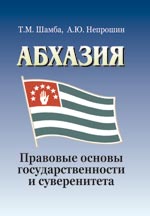
Shamba T., Neproshin А. Abkhazia: Legal basis of statehood and sovereignty. М: Open Company "In-Oktavo", 2005, 240 pages.
Далее читайте:
Абхазы -
(самоназвание апсуа) автохтонное население Кавказа.
Абхазия
(краткая историческая справка).
Исторические лица Абхазии (биографический справочник).
|
